

From Evaluation to Adoption: What It Takes for Digital Mental Health Technology to Earn a Yes

By Fiona Brandon, MPS, MA, LMFT| APA Labs Expert Network

Your technology has been independently evaluated. The results are strong. So why hasn't a clinic, health system, employer, or payer said yes?


Evaluation shows what a technology does. Adopters also want to know whether it will work for them and whether they can rely on it. Clinicians, health systems, employers, and payers each weigh different factors, and knowing what earns their confidence can turn a strong evaluation into a yes.


We asked our APA Labs Expert Network a central question for founders: What does a digital mental health technology need to demonstrate to move from successful evaluation to real-world adoption? Below, an Expert Network member offers practical guidance on closing the gap between evaluation and adoption. Below, one expert offers practical guidance on closing the gap between evaluation and adoption.

1.  Evaluation Is an Input, Not the Finish Line

Evaluation can answer important questions about a technology, but adoption introduces a different set of considerations.


We asked:

What can a strong evaluation tell a potential adopter, and what questions may still need to be answered before a clinician, health system, employer, payer, or other organization says yes?


Expert Perspective:

A strong evaluation can show whether a technology does what it claims, how well, for whom, and with what risks. Adoption raises questions of fit: is this evidence relevant to our setting, and what else do we need to know?


The following questions of fit cut across potential adopters, including clinicians, health systems, employers, payers, and other organizations. Each is likely to ask them, and companies that can answer them are more likely to earn a “yes.”


  1. Will the technology work for our people, with our data and systems, and keep working over time? How will you help assess whether the evaluation findings apply to our setting and monitor whether performance changes after launch?

  2. Have you assessed bias and unequal performance across the populations we serve? What do you know about differences across language, age, culture, gender, disability, and clinical complexity? Where are there gaps in the evidence?

  3. What happens to the information people share? How will information be stored, who can access it, how it is used, is it used to train AI models, and what choices do users have about those uses?

  4. Where does a human stay involved? Which decisions does the technology make or influence? Who reviews them, and what time, information, and authority do they need to question or change the outcome?

  5. How will we know if it fails? How will you help detect not only obvious errors, but also plausible yet incorrect outputs, missed warning signs, or patterns of harm that may otherwise go unnoticed?

  6. If serious risks surface, what will you do? Whether the issue is a safety concern, a data breach, a harmful output, or an error in a record, how will you detect it, how quickly will you notify us, and how will you contain the problem? Which responsibilities fall to you, and which fall to us?

  7. What happens when the technology is not helping some users? How will you help us identify people or groups who are not benefiting, or whose experiences are worsening? What will you do in response, whether that means adjusting the product or helping establish a clear path to other support?

  8. What new responsibilities will this technology create, and who will carry them? How will you identify and make visible the work and risk shifted onto clinicians, staff, or users, such as reviewing outputs, responding to alerts, or catching errors? What support will you provide so we can assess whether those responsibilities are manageable?

  9. What would lead us to pause or stop using the technology? Will you work with us to agree on warning signs and stopping conditions before launch, and support a smooth transition if we stop, including protecting people’s data and continuity of support?

  10. What happens when you change the product? How will you notify us about changes to its functions, AI model, or data practices, explain their implications, and provide evidence that supports continued use? Which changes will require renewed review, and can we defer an update or pause use while we assess it?

Answering these questions can clarify where the technology offers meaningful benefit, what remains uncertain, and what each stakeholder would need to do to support responsible use before and after launch.

2. Not All Evidence is the Right Evidence

A company may have credible evidence, but decision-makers still need to determine whether that evidence is sufficiently robust and relevant to their population, environment, workflows, and intended use. 


We asked:

What makes evidence useful for a real-world adoption decision, rather than simply scientifically credible?


Expert Perspective:

Scientifically credible evidence helps decision-makers understand a technology’s effects. Useful evidence helps them judge whether it will have a positive impact on the organization and their end users. That means answering questions such as: What difference would the technology make compared with what we already offer? Did the study measure the benefits that matter most to us and to the people who would use it? And what would we need to put in place to achieve similar results?


Adopters need to understand what supported the study’s results: the human support, training, follow-up, and staff involvement participants received. They also need a realistic account of the resources and costs involved. Without that information, it is difficult to judge whether similar results are achievable in their setting.


For AI coaches and tutors evaluation should examine the human–AI interaction, not only the model’s performance. That includes psychological competence: how responsibly the system responds to people’s needs and vulnerabilities. For tools that automate tasks or guide decisions, adopters may also need to understand whether ongoing use strengthens or weakens people’s skills and independent judgment.

3. What Else Determines Whether a Technology Is  Ready for adoption?


Evidence is important, but adoption may also depend on factors such as usability, safety, trust, implementation, clinical workflow, accessibility, and how well the technology addresses an actual need.


We asked:

Beyond evidence of effectiveness, what are decision-makers looking for when determining whether to integrate a technology into their or practices environments?


Expert Network:

Beyond effectiveness, adoption depends on readiness on both sides: whether the company can deliver and support the technology in the proposed setting, and whether the organization has the capacity to integrate and use it responsibly.


This requires a clear understanding of the need the technology addresses and how it will fit into existing services and workflows. Both sides need to discuss what will change, what will remain in place, and whether the people involved have the time and resources to manage the transition.


Before deciding, the company and the organization would need to look at practical arrangements: compatibility with existing systems, accessible onboarding and guidance, staff training, technical support, and funding to sustain use beyond the initial rollout.


Readiness also requires clarity about who would be responsible for implementation, reviewing concerns, and deciding when action is needed. Staff and users should understand what to expect, where to ask questions, and what choices they have. Organizational approval should not be mistaken for user acceptance of the technology.

4. What Does It Take to Earn a “Yes”?


We asked:

What are the 3–5 things you believe a digital mental health company should be prepared to demonstrate to an organization considering adoption?


Expert Perspective:

A digital mental health company should be prepared to turn its claims into specifics an organization can examine and, where possible, to show rather than describe. Five things would help:


  1. An evidence summary for the proposed use. The company can deliver a short report explaining how its findings apply to the population the organization serves and the way it plans to use the product. An honest summary also names where assumptions enter and which gaps need further study or a local pilot.

  2. Use-case scenarios, worked through together. Testing realistic scenarios with the organization’s staff lets them see how the product handles errors, unclear input, and sensitive information, and when human judgment is needed.

  3. A pilot plan built with the organization. Designing the pilot together means agreeing on what success looks like, the staff time and support required, and what would lead to expanding, adjusting, or stopping.

  4. Examples of users shaping the product. Specific changes made in response to user input, including concerns, show that feedback is taken seriously. The company can also explain how that feedback will continue to inform decisions about use and interaction design.

  5. Experience with comparable organizations. The company can share how the technology has worked in similar settings, including what succeeded and how challenges were resolved.

Presenting findings is only part of earning a “yes.” Both sides need to understand what they would be agreeing to, what each is responsible for, and how they would work together to make adoption succeed.

Share this insight:

Read more insights from APA Labs

September 1, 2026
Thousands of Apps, No Shared Standard: How Digital Mental Health Earns Its Way Into Care

August 12, 2026
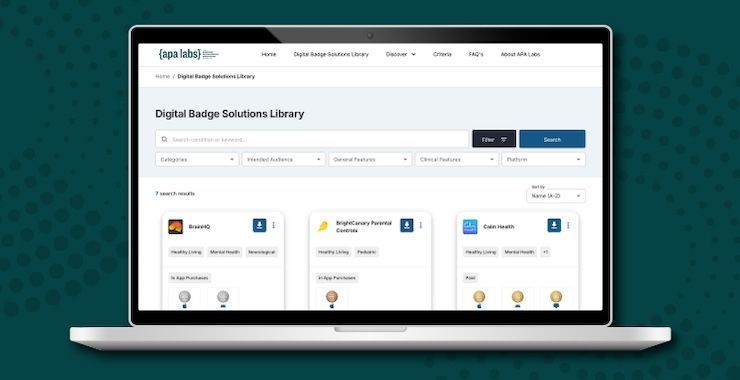
APA Labs Digital Badge Solutions Library Reaches 10 Organizations with Latest Additions
July 6, 2026
Abstract Demand is growing for safe, effective AI systems and digital mental health tools as users increasingly turn to them for support. In this News and Perspectives article, JMIR Correspondent Simon Spichak reports on a new initiative by the American Psychological Association, speaking with Managing Director Tanya Carlson about how the Digital Badge Program is helping developers improve their tools. Key Takeaways: The American Psychological Association (APA) developed the APA Labs Digital Badge Program to help developers improve their mental health apps. When the program presents companies with gaps related to security, usability, or other factors, they work to shore up their product to earn a bronze, silver, or gold badge. The APA is hoping the program will set a de facto standard for developers. Simon Spichak is the cofounder of Resolvve, a low-cost virtual therapy clinic. He has no financial or commercial relationship with APA Labs. Many around the world are turning to AI-powered chatbots for mental health support. These tools aren’t necessarily designed to be safe and effective clinicians and may leak sensitive information to third parties . The American Psychological Association (APA) is hoping to pave the way for safe, evidence-based mental health tech with the rollout of the APA Labs Digital Badge Program and the Digital Badge Solutions Library of apps that have gone through the program. While some libraries, like MindApps.org , provide prospective users with safety and privacy information, and MindBench.ai provides an independent audit of AI systems, the Digital Badge Program also allows companies to earn certification and shore up the quality of their apps. Based on the evaluation, which assesses criteria such as regulation and safety, data protection and privacy, and usability and accessibility, APA Labs provides a bronze, silver, or gold badge. JMIR Publications spoke with Tanya Carlson, MBA—managing director of APA Labs—about the program, how it works, and whether it’s improving the quality of digital mental health apps. The interview was edited for concision and clarity. How would you describe the Digital Badge Program and the Digital Badge Solutions Library? ... Continue reading the full article on JMIR Publications
Show More